‘Whatever Happens, We have to Deliver’: Platform Labour in the Age of Polycrisis

by Stephanie Nicolle
A Sri Lankan gig worker, popular for his delivery vlogs, begins filming another package run. Strong winds shake his motorbike as he rides along the Southern coastline, prompting him to briefly stop. His phone receives an alert: Cyclone Ditwah is imminent, and his route is at high risk. He notes that whatever happens, he has 40 kilometres left to complete his delivery. In the aftermath of Cyclone Ditwah that hit the island on 27th November 2025, over 600 lives were lost, road networks were severely damaged, and entire towns were submerged.
His story, viewed over 70,000 times on Facebook, is one of many that expose the adversity that geographically‑tethered gig workers confront as they transport food, parcels, or passengers. While precarity has long defined informal labour, digital platforms have introduced new vulnerabilities. The much-celebrated freedom and choice that gig workers are said to enjoy are at odds with the reality of opaque algorithms that determine routes, timelines, and pay without sufficiently accounting for converging crises and ground realities.
How Platform Promises Unravel Under Polycrisis
For ride‑hailing and delivery workers on Sri Lanka’s leading platforms, the polycrisis of COVID-19 impacts, a debilitating economic crisis of 2022-23, and the effects of climate change have become the normalised backdrop of their work. To be sure, during these periods, platform work has held strong appeal by offering low barriers to entry and autonomy for workers beyond typical ‘9-to-5’ jobs. Platforms ostensibly position these workers as ‘partners’, masking the precarious nature of their jobs as independent contractors.
Despite the promise of freedom and flexibility, the realities can be quite different. Gig workers stay logged on for extended hours and depend on this work as their main source of income. In 2024, 93% of Sri Lankan app-based drivers surveyed by the Solidarity Centre worked over 11 hours a day, while over a third exceeded 16 hours. An overwhelming majority of workers interviewed between 2021-25 by the Centre for a Smart Future (CSF), a Colombo-based think tank, also reported that they work on these platforms full-time – making this work more than just a ‘gig’, but rather de facto employment. Any disruptions, whether from external shocks or platform policy changes, directly impact their earnings. During the 2022 economic crisis, for example, fuel shortages and platform commission hikes forced drivers to either accept shorter rides and reduced incomes or exit the platform in search of alternative livelihoods.
The lack of transparency in platform algorithms can leave workers more exposed to sudden shocks and risks. Critics have gone so far as to label algorithmic systems as an ‘invisible cage’ that subjects workers to continuous surveillance, data extraction, and sudden changes in performance benchmarks – all while withholding full transparency. Platforms have long resisted revealing details of their algorithmic management of work, citing intellectual property reasons. While worker choices may appear autonomous, those choices are in fact made under uncertainty and pressure, with little knowledge of how the system will react to refusals to accept a ride or delays in deliveries.
Platforms also incentivise target-chasing behaviour, such as offering cash bonuses for completing a higher number of orders in a fewer number of days. For instance, workers on Sri Lankan platforms reported being offered Rs. 10,000 for completing a target of 145 orders in 4 days. These are generally built on assumptions of stable operating conditions and rarely account for unsafe environments (caused by extreme heat or flooding, for instance) and unpredictability in traffic congestion in the city. Workers stretch their physical limits to meet these demands, with little safeguards for occupational health and safety.
Weathering Precarity
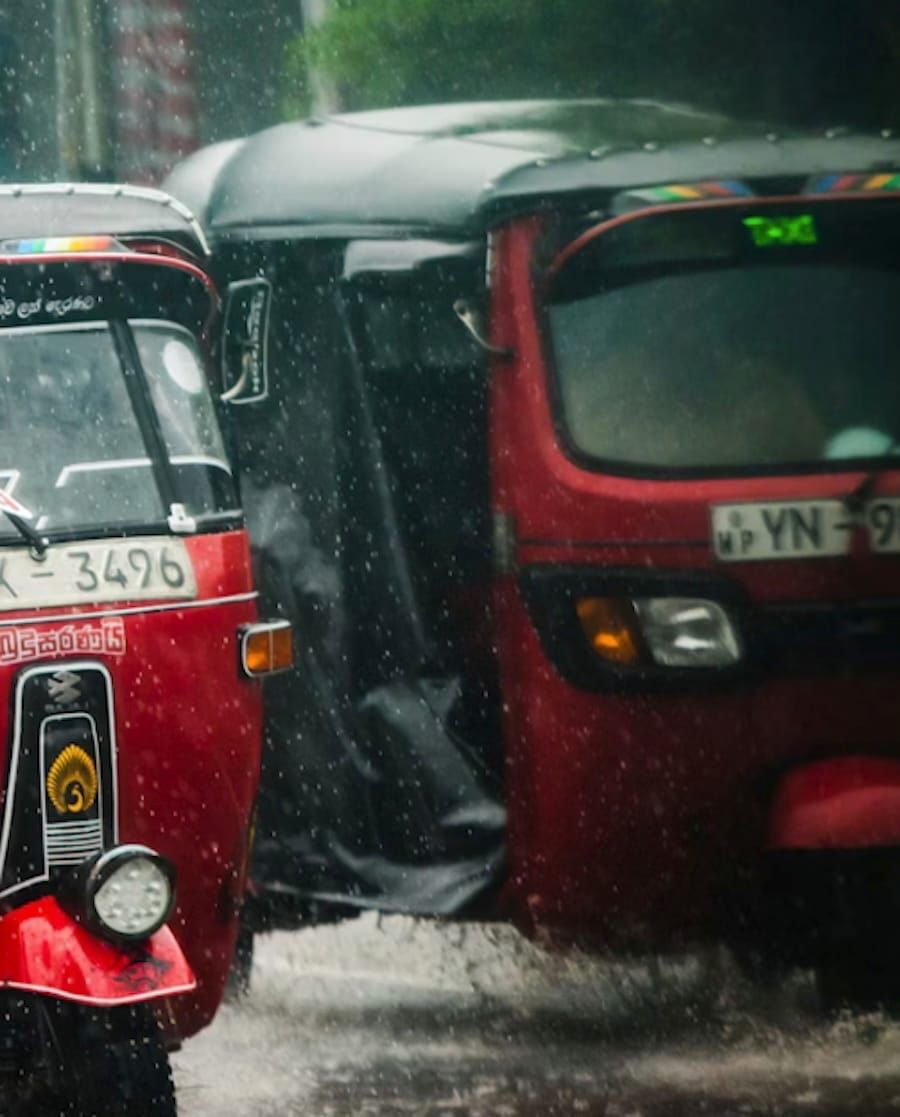
Colombo’s streets now illustrate how climate stress is a ‘wicked multiplier’. Urban heat is rising, with Colombo experiencing heat stress throughout the year, recording consistently high temperatures above 27°C. Increasing economic activity, high-rise construction, and road congestion are exacerbating urban heat island effects. Air quality in the city is becoming adverse more regularly, with ‘unhealthy’ levels particularly reported from late 2024 to early 2025. Climate change is also increasing the incidence of flooding, with the city’s road and drainage infrastructure unable to cope during heavy rains.
Platforms typically treat these changes as a supply and demand equation. As one rider explained, “When it rains, the number of orders usually increases as more people order because they can’t go out.” Algorithms respond with surge pricing, nudging workers to stay logged on precisely when conditions are most hazardous. In Vietnam, the Grab platform introduced a surcharge for days where temperatures exceeded 35°C, but soon dropped it after pushback and intervention from the country’s consumer protection authority. The algorithm rewards endurance, but workers bear the cost through fatigue, dehydration, heat stress, and accidents.
“12pm-2pm is hot,” one driver shared, further stating, “even if I got a job during this time, I would take it as it is income for me.” Another observed, “There is no such thing as sun or rain; we continue to do our deliveries.” Amidst Sri Lanka’s polycrisis that has worsened urban poverty, increased the cost of living, and made livelihoods harder, economic desperation forces workers to keep operating, against climate stress and algorithmic pressures.
No Safety Nets
International conventions such as the Promotional Framework for Occupational Safety and Health Convention, 2006 (No. 187) recognise workers’ right to safe and healthy working environments. Local labour laws, like the Factories Ordinance No. 45 of 1942, similarly have strict measures for maximising healthy and safe conditions, including maintaining reasonable temperatures. But these rarely apply to platform companies and the gig workers that are part of them.
Platforms often use classification loopholes – where gig workers are employed as independent contractors and not formal employees – to sidestep safety obligations. While some platform insurance schemes exist in Sri Lanka, coverage tends to be conditional on factors like driver ratings, suggesting that workers’ lives are valued according to their productivity. Even protective gear is inadequate, as noted by one delivery rider, “If I use the raincoat that (the platform company) gave me, half of my body will get wet, and I will end up sick.”
Avenues for collective bargaining and representation are also limited. While Sri Lanka’s Trade Unions Ordinance does not bar contractors from unionising, gig workers cannot register unions because their employer is undefined. In 2022, CSF found that only 11% of ride-hailing and 19% of delivery riders noted that their platforms recognised their worker association.
Without sick leave, predictable income, and collective bargaining rights, gig workers exist in a state of perpetual vulnerability that climate change is rapidly worsening. They navigate failed institutional support and the city’s lack of care infrastructure by modifying vehicles for shade or wearing multiple layers against UV exposure at their own expense, while also relying on religious establishments or small shops for water and restroom facilities.
Reimagining Platform Work for a Polycrisis Era
As intersecting crises worsen, the burden of keeping services running falls disproportionately on those least protected. A just ecosystem begins with all those who benefit from platform activity acknowledging these issues and committing to a fairer sharing of benefits and protections.
Governments have a role to play through improved policy and city planning. As a starting point, national authorities must capture gig work in labour statistics and incorporate regulations on occupational health and safety and social protection. Sri Lanka may draw inspiration from global measures such as Singapore’s Platform Workers Act, which covers compensation, representation, and contributions for housing and retirement. Investing in public commons that support outdoor work, including drinking water stations, increasing green cover, shared rest areas, and clean toilets, can ease daily burdens. Universal design principles would allow such infrastructure to withstand hotter temperatures, heavy rains and floods.
Platforms, too, must rethink their models. No other occupation in Sri Lanka allows incomes and incentives to be determined in such opaque and undocumented ways. This makes algorithmic transparency critical, especially as more workers rely on this type of work for full-time employment. More transparent communication, clearer safety guidelines, and workshops in vernacular languages can help workers understand what protections are available to them or how to recognise and respond to risks. These may be complemented with physical drop‑in sites to address grievances, and distributing protective equipment that meets quality standards.
For too long, platform economies have grown by transferring risk downward, but increasingly this approach is under sharper scrutiny. Just last month, in major Indian cities, gig workers across multiple delivery platforms went on strike, citing unsafe ‘10-minute delivery’ deadlines, opaque algorithmic management, and a lack of social security and job security.
A safer, more sustainable ecosystem can take shape by balancing platform innovation with accountability and introducing meaningful protections so that the workers who keep our cities moving are no longer left to weather crises alone.
About the Author
Stephanie Nicolle is a Research Associate at Centre for a Smart Future (CSF), an interdisciplinary think tank in Sri Lanka. The article draws from research on platform-based gig work, urban heat stress, and social protection across two of CSF’s thematic pillars - ‘Inclusive Technology and Innovation’ and ‘Urbanization and Cities’.