The Human Signal: How African Futures Rewrite the Global Tech Script

by Divine Nwobodo Chidera
In a shared workspace in Yaba, Lagos, a software developer is training a small language model to understand Yoruba proverbs. The system translates the words accurately, yet consistently misses the wisdom hidden in pauses, tone, and cultural context. “It understands the sentence,” she says, “but not the silence inside it.”
This is not the version of Artificial Intelligence (AI) dominating global headlines. There are no trillion‑dollar valuations here, no promises of mass replacement. Instead, something more deliberate is happening. Across African tech ecosystems, innovation is unfolding not as spectacle, but as survival, creativity, and cultural negotiation.
As 2026 approaches, much of the world is anxious. Machines are learning to act, not merely respond. Algorithms anticipate behavior, shape attention, and increasingly define economic value. Europe debates regulation, the United States debates market dominance, and China debates efficiency. Across many African countries, however, the debate is different. The central question is about meaning. And there, a different kind of digital future — one less obsessed with acceleration and more rooted in survival, creativity, and cultural truth — is taking shape.
This essay is a searchlight on that transformation.
The Year Machines Stop Whispering
Everywhere you look, tech is becoming emboldened.
AI models don’t just assist; they anticipate. Content doesn’t just entertain anymore; it engineers emotion. Our devices are learning to “act,” not obey. The line between the user and the used is dissolving.
While debates vary across the world, in Africa the debate centres on meaning- technology here has never been neutral. It has been savior, colonizer, storyteller, liberator, and sometimes all four in the same sentence.
In 2026, that context becomes power.
Beyond Consumption: Africa as a Tech Creator
For years, global narratives framed Africa as a late adopter. Behind. Emerging. Developing. Outpaced.
When you don’t inherit old systems, you’re freer to build new ones. That’s why African developers are writing AI models trained on Indigenous languages before the rest of the world even considers them “data.” It’s why community networks in places like Kenya, South Africa, and Nigeria thrive where big telecoms fail. It’s why digital marketplaces built from scratch are outperforming imported platforms designed for different cultures entirely.
The following are just some of the many examples that demonstrate African tech isn’t simply ‘catching up’- it's remixing the rules.
1. Indigenous-Language AI (Masakhane & AfricaNLP)
While Big Tech ignored African languages, African researchers built Masakhane, a decentralised natural language processing (NLP) network creating machine translation models for Yoruba, Zulu, Amharic, Igbo, Kiswahili, and dozens more. No corporate funding. No Silicon Valley blueprint.
Just communal intelligence.
Africa didn’t wait for inclusion.
It built its own lane and the world now studies its approach.
2. Mobile Money Was Born in Africa (M-Pesa)
Long before Apple Pay or Google Wallet existed, Kenya launched M-Pesa, a mobile money platform that transformed financial life across East Africa. It became the global prototype for mobile banking.
Innovation didn’t flow to Africa- it flowed from Africa.
3. DIY Internet Infrastructure (Zenzeleni, BRCK, TunapandaNET)
When traditional telecoms failed rural communities, Africans built their own networks
- Zenzeleni (South Africa) — a community-owned ISP.
- BRCK (Kenya) — rugged internet devices built for unstable power grids.
- TunapandaNET (Kenya) — an intranet-style community network that connects local schools and centres to educational content.
Africa didn’t follow the global infrastructure model.
It invented systems that fit its realities.
4. Nollywood Rewrote Global Content Logic
While Hollywood perfected slow, high-budget perfection, Nollywood built speed, scale, mobile-first distribution, and local streaming platforms like iROKOtv and Showmax.
It became the world’s case study for grassroots digital entertainment.
5. Precision Agriculture Made Local (Zenvus, UfarmX)
African agritech startups such as Zenvus (Nigeria) developed affordable AI-driven soil sensors and precision farming tools that outperform many imported solutions — because they understand African land and climate better than any foreign dataset.
This is not Africa playing catch-up.
This is contextual innovation of the sharpest kind.
Africa breaks the rule that tech only advances in capital-heavy environments.
The continent’s greatest export in 2026 won’t be minerals or music.
It’ll be approaches; ways of thinking that force global systems to reconsider what “innovation” actually serves.
Memory as Resistance, Not Nostalgia
In a world drowning in data and starving for meaning, Africa is restoring the human signal; the cultural frequency that machines cannot replicate through digital memory.
1. Digital Language Revival
Projects like YorubaName.com, AI-powered Shona dictionaries, and Kiswahili translation models don’t digitise language for nostalgia.
They weaponise identity for a digital age.
These tools ensure cultural memory doesn’t get filtered out by the algorithmic world.
2. The Digital Benin Project & Open Restitution Africa
Thousands of stolen Benin artefacts were digitally reconstructed and catalogued by Digital Benin, allowing Nigerians to reclaim narrative power even before physical restitution.
This isn’t sentimental.
It’s political technology — memory as self-definition.
3. Electric South & Leti Arts
African XR studios are merging folklore with immersive tech.
VR stories centered on trauma healing, ancestral worlds, and myth rebirth aren’t backward-looking — they are cultural reinventions for a new century.
Africa restores memory not by preserving it in glass cases, but by remixing it into future tools.
Connectivity as Community, Not Monopoly
The Western model frames connectivity as a corporate service.
The African model frames it as a collective right.
Solar-powered routers, locally-managed networks, diaspora-funded innovation hubs — this is what happens when people stop waiting for institutions that never arrive.
When systems fail, Africans build systems that refuse to fail.
2026 exposes a global truth Africa learned early:
Decentralisation isn’t a buzzword — it’s survival.
The Economy of Reinvention
When automation destabilized traditional work structures globally, African creators didn’t panic — they adapted. The continent has always thrived on reinvention.
Now that spirit fuels tech we have one-person AI consultancies, mobile-first media studios, self taught developer collectives, micro-influencer economies, and diaspora-backed innovation cycles.
The world is now studying Africa not as a consumer market, but as a model of economic elasticity.
Afro-futurism Steps Beyond Aesthetics
Afro-futurism — once seen as glitter and sci-fi — is now shaping policy and ethics.
African futurists influence debates within: AI governance panels, digital identity initiatives, climate-tech strategies, and cultural preservation councils.
They argue that technology must serve the community, not override it. Innovation must protect identity, not erase it. Digital futures must remain human-centered.
In a world sliding into machine autonomy, these ideas matter more than ever.
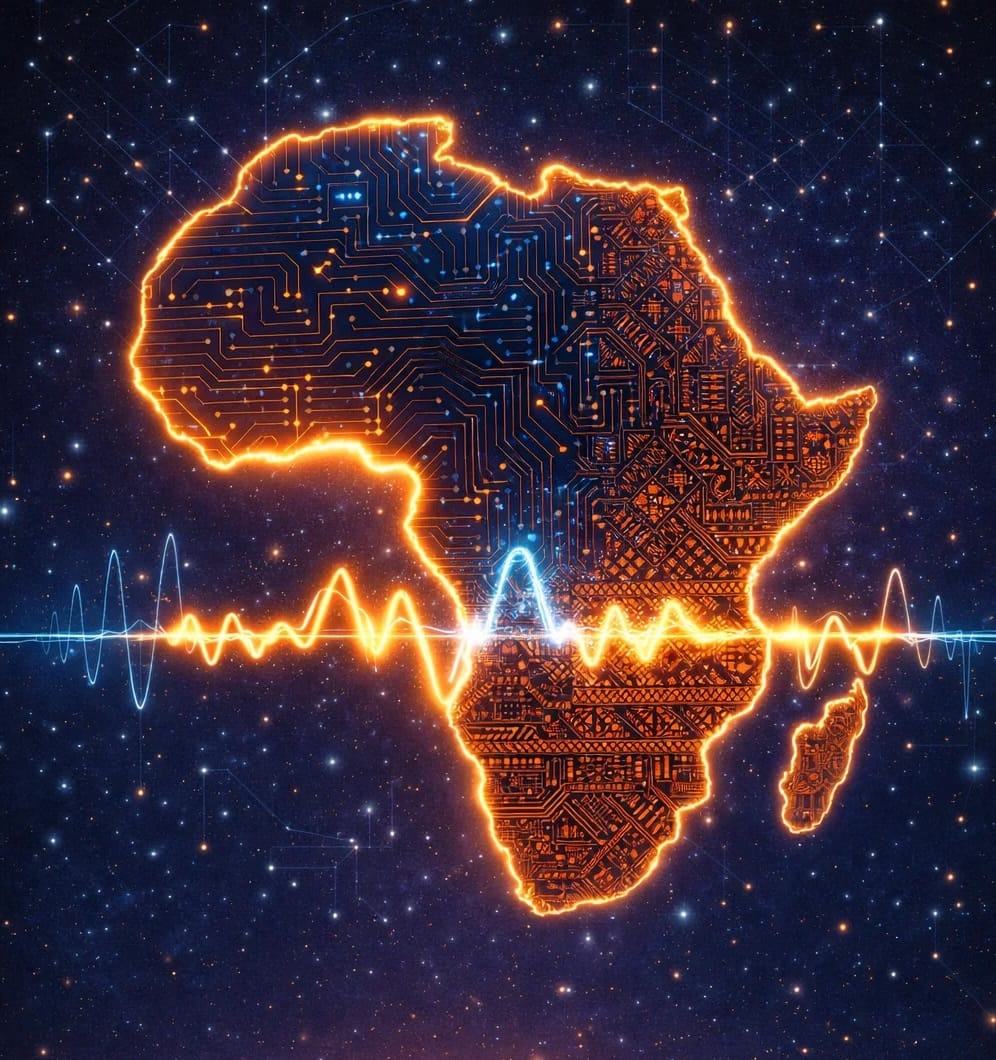
The Human Signal
Here’s the truth 2026 can’t ignore:
The world fears losing its humanity in the noise, drowned out by algorithms, automation, and endless extraction of data.
Africa is amplifying the signal, the distinctly human frequencies that technology was meant to serve: memory, meaning, community, and cultural continuity. This isn't resistance to technology.
It's a recalibration of what technology should amplify.
Not through nostalgia or romanticised history.
Through reinvention — adaptation, creation, translation, reclamation.
You see it everywhere: In Lagos, coders build Yoruba-trained chatbots. In Kenya, farmers are usinghyperlocal climate AI. XR artists are resurrecting stolen worlds. In South Africa, communities are running their own internet. In Ghana, digital marketplaces free artists from intermediaries.
Africa’s digital future isn’t loud.
It’s precise.
Not a sprint toward the new — but a weaving of the old into the possible.
The Future the World Needs
2026 is heavy with uncertainty — AI overreach, unstable systems, climate urgency, and data colonialism.
The dominant global instinct is to control more, centralize more, automate more.
Africa suggests something different:
What if the future is not about speed, but meaning?
What if technology doesn’t replace people — it extends them?
What if communities, not corporations, are the true innovators?
Africa isn’t just adapting to the future.
It’s redesigning it.
Rewriting the Global Script
The world expected Africa to follow.
Instead, Africa rewrote the map.
Not through imitation.
Through imagination.
Not through nostalgia.
Through living memory.
Not through catching up.
Through remixing the rules.
In an age desperate for humanity, Africa offers a blueprint grounded in community, identity, resilience, and reinvention.
2026 belongs to the ones who can stay human in a world of restless machines.
Africa is already there, holding steady the signal that the rest of the world is struggling to hear: that technology without humanity is just machinery, that innovation without memory is just disruption, and that the future worth building is one where people, not platforms, determine meaning.
The human signal isn't fading.
It's just been broadcast from a different frequency all along.
Author Bio:
Divine Nwobodo Chidera is an Afrofuturist writer and AI enthusiast based in Nigeria. As an undergraduate at Enugu State University of Science and Technology (ESUT), he explores how African tech ecosystems are redefining innovation beyond Western frameworks. His writing, which has appeared in DeSci NG, examines the intersection of speculative fiction, digital culture, and African futures.