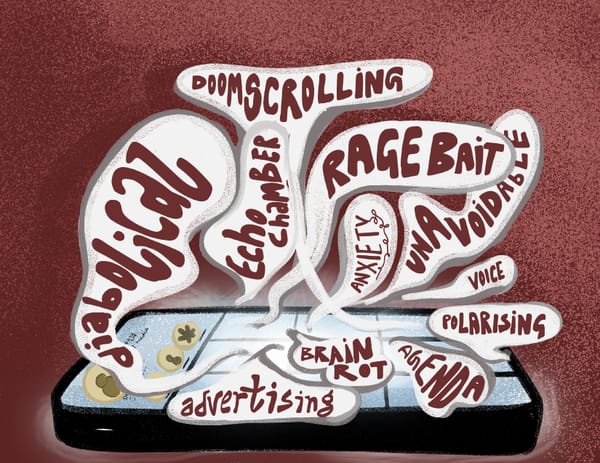
Inside Nepal’s experiment with Digital Democracy

by Samik Kharel
Over three months after a Gen Z uprising toppled Nepal’s government, the revolution has not ended.
What began in September 2025 as protests against a sweeping ban on major social-media platforms has since evolved into something far more complex- an ongoing struggle over political meaning, legitimacy, and power, now unfolding almost entirely in digital spaces. Streets once burning with slogans and tear gas have quieted. Meanwhile, Discord servers, TikTok feeds, livestreams, podcasts, memes and AI-generated visuals have become the primary arenas of political contestation.
Nepal is now racing toward national elections scheduled for March 2026, an electoral moment that will test whether the country’s unprecedented experiment in digital democracy can survive contact with realpolitik.
At the center of this transition is a generation that has come to believe that digital freedom is political freedom, and that control of platforms can determine the fate of governments.
A Server that Wouldn’t Shut
“Nepal politicians lack discipline and so do voters,” writes a user named kIRA.
“All illiterate goons become ministers here,” adds Mika.
“Seventy-six people must get justice. That’s all I wish,” says GenZ, referring to those killed during the protests.
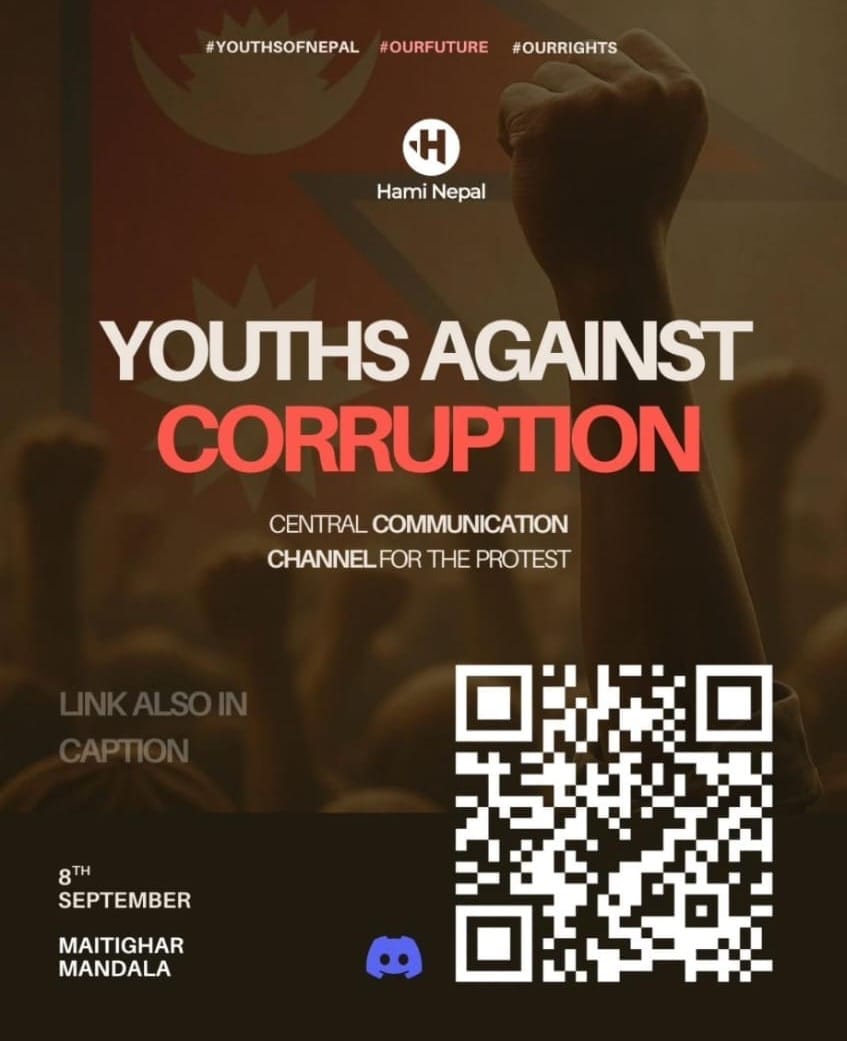
These messages appeared on Youth Against Corruption, the Discord server that helped coordinate the Gen Z demonstrations, amplify outrage, and most astonishingly host an online poll that selected Nepal’s interim leadership of Sushila Karki after the old political guard fled. The server still houses 155,000 participants, among whom over 6000 are mostly online as hundreds of messages are exchanged everyday.
Many have dismissed the server as a chaotic chatroom run by anonymous youths, but this virtual room has not faded into irrelevance. Instead, it has become a living archive of Nepal’s political anxieties and a microcosm of the country itself.
From its uncertain beginnings, Youth Against Corruption evolved into a sprawling digital commons. Today it hosts hundreds of discussion threads, ranging from “Communism vs Capitalism” and “Monarchy” to “How can we end corruption?” and debates over who should lead the country next. Threads like “Balen as PM,” “Why Not Harka Sampang?” and “Your Thoughts on Rabi Lamichhane” dominate the feed as if Nepalis are desperately looking for a singular leader. All those mentioned above- Balen, Harka and Rabi- are populist politicians evolving as alternatives, stepping on the discontents of the youth and notably all of them with enormous social media following.
As of January 7, 2026, the name Balen Shah alone had been mentioned more than 16,000 times on the discord server, followed by Harka Sampang and Rabi Lamichhane, all seen as a glimmer of hope for the upcoming elections.
The conversations in the server are chaotic, global, and intensely ideological, swinging from Venezuela to Morocco, from Hegel to Jordan Peterson before inevitably circling back to Nepal’s own abundant and unresolved crises. Corruption scandals, criminal cases, impunity for violence, support and criticism of federalism, and the failures of traditional parties dominate the discourse.
Despite the noise and polarization, the server still carries what many participants see as core tenets of democratic space- the ability for anyone to speak, argue, persuade, and belong.
Digital Power with Material Consequences
The Gen Z uprising was made possible by digital platforms, but it also revealed their darker edge. The protests that toppled the government inflicted significant national damage. Public buildings were torched. Private businesses were looted . Violent groups infiltrated demonstrations, leaving behind destruction and fear. While vigilantes melted back into anonymity, the digital trail they left behind did not.
An accord signed between Gen Z leaders and the interim government formed after the protests elevated digital rights from a street level demand to an official political commitment. Among its priority clauses was an explicit guarantee of freedom of expression, access to social media, and the free flow of information. Clause 8 of the agreement commits the state to preventing arbitrary or unlawful regulation, restriction, or censorship of online expression and communication on digital platforms. It also pledges legal, physical, and technical safeguards against unlawful surveillance and the misuse of citizens' digital data by both the state and third parties. In a marked departure from past practice, the accord further requires the government to make its decisions, operations, and expenditures transparently accessible, not only through official notices or government websites, but through social media and widely used digital communication channels. For Gen Z activists, protecting the internet was not secondary to governance, it was foundational.
However, much of the evidence now being used for investigations of the protest comes from mobile phone footage, posts, and reels shared online. During the height of the unrest, Nepal’s security forces remained largely paralyzed. In the aftermath, the Nepal police appealed to citizens to submit videos from social media, turning to Instagram reels, Facebook feeds and TikTok clips as digital forensic archives.
This inversion of surveillance power, where citizens documented the state, and later the state relied on citizens’ recordings has marked a profound shift in accountability and questioned the process of how security forces will use these pieces of evidence for their investigations. Yet it also raised unsettling questions about consent, privacy, and selective justice in an algorithmic age.
From Streets to Screens
The Gen Z campaign did not simply use digital platforms, it redefined political participation through them. The movement has metastasized all over the social media platforms, which can be witnessed among the hundreds of Gen Z groups on Facebook and Instagram. Even the old political parties against which the Gen Z revolted, have formed their own Gen Z alliances and set their footprints on digital platforms by creating pages and handles on social media platforms.
Gen Z frontrunners bypassed legacy media by broadcasting directly from their phones. Livestream and lengthy status’ replaced press conferences and releases. TikTok, Facebook and Instagram became tools for civic education and persuasion. Memes acted as arguments while livestreams became rallies.
This shift has persisted beyond the protests. Political debates now emerge online first, with street mobilization often following digital momentum rather than preceding it. Relevance is measured less by party hierarchy or institutional authority and more by visibility, virality, and circulation.
Even traditional parties have been forced to adapt to this, though often clumsily. Candidates now compete not only on ideology but on engagement metrics. Popularity has become political capital. Political parties are using the 'Proportional Representation(PR)’, which are party nominations made for parliament seats granted without running in the election. The purpose of the allocated PR seats are to ensure inclusion, however now being distributed to people mainly from the glamour industry with a huge social media following. As one critic put it bluntly, “You don’t need political acumen anymore. You just need followers.”
The Algorithmic Candidates
Few figures embody Nepal’s new algorithmic politics better than Balen Shah, the rapper-turned-mayor of Kathmandu (now resigned to contest elections) and now a vying candidate for upcoming elections. After being elected, Shah has never held a formal press conference. He has never given interviews to local journalists, only providing a few to international media like the New York Times. His opinions, criticisms, and endorsements arrive instead as cryptic social-media posts, often controversial, always widely shared. Critics accuse him of existing only “online”, yet his reach dwarfs that of most traditional politicians. Shah has over 3.4 million followers on Facebook on one of his many official accounts and numerous mirrored ones. Shah’s refuge is social media, with his posts often going “viral” in a matter of minutes. Infiltrators have also used a look alike Facebook screenshot to make some ‘obscene’ and ‘racist’ remarks to Kulman Ghising, a popular politician and an election candidate.
Harka Sampang, a political candidate for the upcoming elections and former mayor of Dharan (a city in the east of Nepal), utilises similar tactics. He has balanced social and traditional media with frequent public appearances. However, he also leans heavily on social media for his popularity, often posting parody songs and banal jokes. Sampang is seen to have embraced AI-generated content to amplify his image. One viral AI video shows him winning a chain-pull contest against rival candidates. In another, he is seen using the recently controversial Grok image editing to remove individuals embroiled in scandals from images, a tactic aimed squarely at his political opponents using the latest digital trend.
Even the old guard has joined the image manipulation bandwagon. The Communist Party of Nepal (Unified Marxist–Leninist), led by former prime minister KP Oli (deposed after Gen Z protests), circulated doctored images exaggerating crowd sizes at party conventions, despite real photos showing sparsely attended venues.
With all these dynamics at play, Nepal’s election season has already become a laboratory for deepfakes, face swap tools, voice cloning, misinformation, and other AI-assisted propaganda, raising alarm bells about trust in visual evidence itself.
Digital Democracy and Limits
The irony is difficult to ignore: an interim government chosen through an online poll has shown little urgency in extending voting rights to the digital generation that empowered it.
More than 5.6 million Nepalis, nearly a fifth of the population live or work abroad. Migrant workers remittances account for over 26 percent of Nepal’s GDP. Many Nepalis living abroad were active participants in the protests via Discord servers. Yet overseas voting remains unavailable.
Nepalis at home and across a vast diaspora also mobilized financially in the aftermath of the Gen Z protests, raising funds through crowdfunding platforms such as GoFundMe. Campaigns were launched in various currencies, underscoring both the global reach of the movement and the scale of migrants seeking political engagement.
At the same time, election authorities have moved aggressively toward data-driven campaigning. The Election Commission of Nepal has said voter information will be made available in digital format to political parties, for a fee, raising concerns about privacy and consent, a repeated concern during elections.
To fit the Gen Z mandate, parties are also opting to explore the digital ecosystem. Nepali Congress, the oldest party that held a majority in the last election, has announced its membership could be acquired via filling in an online form. Other political forces carried out internal party elections via electronic and online voting systems, though technical glitches and digital illiteracy among the cadres added hiccups. The promise of digital democracy, it turns out, is easier to invoke than to institutionalize.
The Digital Revolution Lacks Leadership
Perhaps the greatest unresolved question is leadership. The Gen Z movement thrived on decentralization. It rejected hierarchies, spokespeople, and singular ideologies. Narratives spread through repetition, remixing, and algorithmic amplification rather than command and control from above.
This structure allowed the youth led uprising to scale rapidly, but it has struggled to transition into coherent political organization. Three months on, Gen Z remains powerful and vocal but nevertheless fragmented and fractured.
Backers argue that revolutions are not meant to look tidy, especially when led by young people operating beyond traditional systems of power. Political scientists counter that without ideologies, institutions, or leaders, any momentum gained risks dissolving into noise.
After the Scroll
Nepal’s Gen Z uprising demonstrated that political power no longer flows solely through parties, parliaments, or newspapers. Instead, it operates via platforms, codes, algorithms, and the cultivation of attention.
Yet as AI erodes our trust in images, as screen darlings eclipse traditional ideological parameters and as digital spaces grow more polarized, the tools that empowered a generation may also undermine democratic accountability.
The “Youth Against Corruption” discord server still hums. Its tale of a successful uprising inspires and echoes across the world from Madagascar to Mexico, the Philippines to Georgia, with people leaving greetings on the server. The hashtags still trend. The feed still scrolls. The discontent still surrounds.
Whether this digital revolution can survive the ballot box and reshape Nepal’s institutions rather than merely disrupt them will be decided not just on election results, but on whether citizens can trust the digital systems that now shape their political lives.
In Nepal, the future of democracy is being written one post at a time.
Author Bio:
Samik Kharel studies the politics of technology from the ground up. Based in Kathmandu, the award-winning journalist and researcher examines digital governance, tech ethics, and the societal consequences of innovation. Over the past decade, his work has appeared in Al Jazeera, Deutsche Presse-Agentur, The Diplomat, The Kathmandu Post, and The Record.